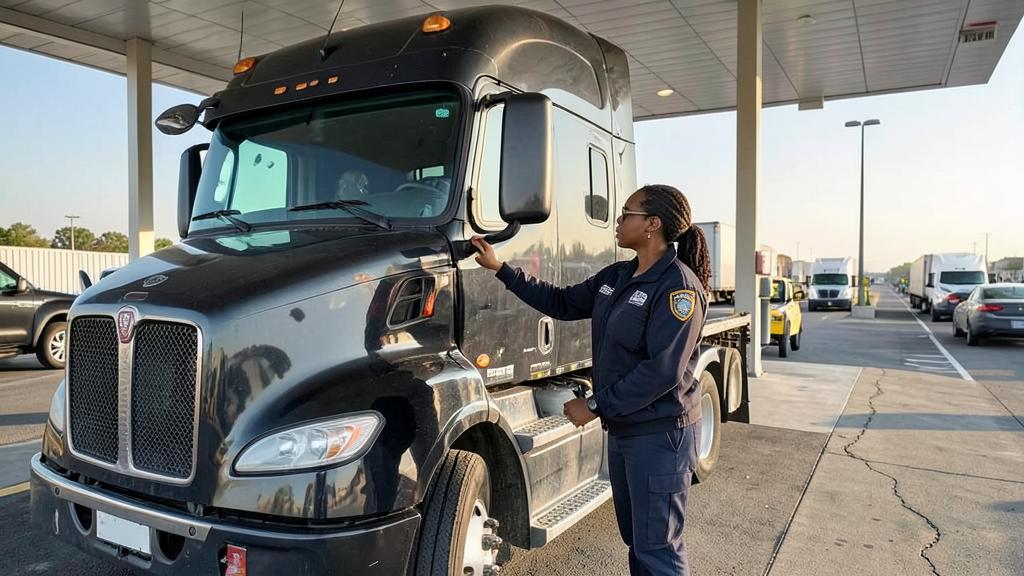
Commercial Truck Driver
Skilled Trades
Move freight regionally or long haul on a tight, safety-driven schedule.
Why it matters here: Port of Baltimore and regional distribution centers hire steadily.
Labor Market — DMV Region
Sourced from U.S. Bureau of Labor Statistics OEWS releases (DMV metro and nationwide) plus MD, VA, and D.C. workforce agencies.
Local cost of living is why DMV pay often differs from the national median.
- DMV & state figures: U.S. Bureau of Labor Statistics — OEWS wage & employment estimates and Employment Projections, with OEWS area pay relatives for the Washington–Arlington–Alexandria metro, Maryland, D.C., and Northern Virginia · View source
- Occupation profiles & skills: O*NET OnLine (U.S. Department of Labor) · onetonline.org
All salary figures are published estimates for groups of workers, not offers or guarantees for any individual role.
Education & Career Pathways
Multiple ways to get here — pick the one that fits your life.
Career Progression
How you can grow — with expected salary at each step.
- Entry-level Commercial Truck DriverLearning the role, supervised work, building core skills.$46,870
- Commercial Truck Driver (experienced)Independent work, mentoring newer team members.$59,210
- Senior / Lead Commercial Truck DriverOwning projects, specialization, higher responsibility.$74,120
- Manager or specialist trackSupervising a team or moving into a high-demand specialty.$88,944
Skills Required
What you'll actually do — and how you'll be judged.
The cab and the road, long regulated hours, solitary
Where you work
The cab of a truck, loading docks, truck stops and customer yards.
Hours and schedule
Federally limited hours of service — typically 11 driving hours in a 14-hour window — with mandatory rest. Local routes come home nightly; regional runs don't.
Pace and pressure
Long steady stretches, with pressure at pickup and delivery windows and in traffic.
Who you work with
Mostly alone, connected to dispatch by phone and app; dock crews and shippers are your daily contact.
Physical demands
Long sitting, climbing in and out, securing loads, sometimes unloading freight.
What people wear
Comfortable work clothes, boots, safety vest at docks.
Remote reality
The job is mobile, not remote.
Workplace culture: what's normal here
- Logbook and hours-of-service rules are audited; falsifying them ends a career.
- Pre-trip inspections are done every day, honestly, even when you're late.
- Drivers look out for each other on the road and at stops.
Source: U.S. Bureau of Labor Statistics, Occupational Outlook Handbook — Work Environment, with regional detail for the DMV.
Official data behind this career
Federal statistics for DMV Region, translated into plain language.
Washington–Arlington–Alexandria, DC–VA–MD–WV metro area
Source: U.S. Census Bureau — ACS 2019–2023 5-year estimates (tables DP03, DP02, DP05)
- The DMV functions as one labor market: workers routinely cross state lines to get to work.
- The largest employment destinations are D.C., Fairfax County and Montgomery County.
Top places these workers go to work
Source: U.S. Bureau of Economic Analysis — BEA regional GDP and personal income, most recent published year
Private-sector payroll data from ADP. It is a supplemental near-real-time indicator and does not replace BLS government employment statistics.
Source: ADP National Employment Report — Most recent monthly ADP National Employment Report
- 1U.S. Bureau of Labor Statistics (OOH, OEWS, Employment Projections, CES) — Primary source for occupation wages, outlook, projected openings, education and training.
- 2U.S. Census Bureau — American Community Survey — Primary source for income, educational attainment, labor force and demographic context by place.
- 3Census LEHD (LODES / OnTheMap) — Primary source for where workers live versus where they work, and local workforce flows.
- 4U.S. Bureau of Economic Analysis — Primary source for regional GDP, industry contribution, compensation and personal income.
- 5ADP National Employment Report — Supplemental near-real-time private-sector employment and pay indicator. Not a replacement for BLS.
Figures describe groups of workers, not any one person. Where an official figure is not published for a category, this page says “Data unavailable for this category.” rather than estimating.
Related Careers
Explore similar occupations with overlapping skills.
Install and repair the electrical systems buildings run on.
Keep heating, cooling, and ventilation systems running safely.
Join metal parts for construction, manufacturing, and infrastructure.
Install and repair the water, gas, and drainage systems buildings need.